If life were free then
wealth would be my game.
If the world didn’t need
a struggle to be in it, my life
would be in vain.
The skies above the earth
beneath
I live between the two.
And the eagle that flies
free, on outspread wings.
Look.
It’s fed.
It has a house yet earns
no bread. Oh woe!
An eagle, I am not.1
Being called a customer makes me feel like a carrot grated into a cheap salad. Tossed alongside lettuce, tomato and chopped-up hard-boiled egg. If we’re lucky, we get olive oil dribbled over us; if not so lucky, then sunflower; and if in a dismal place, then none at all.
But it’s not the word that converts me into a vegetable. After all, what else is a stranger looking to buy something going to be called? Rather, it’s what the word now represents. I’ve now been transformed into a category that requires particular attention, determined by company research. Put into a little box, that has a list, which has a bunch of check boxes to tick off, so I can be happy.
Recently (more or less), funds equating to the collective GDP of a dozen poorer nations have been spent to uncover the secrets of marketing to customers better. Yet, the answer is in plain sight. It fits somewhere in line with the ancient adage of treating others as you would want yourself treated. Though, these days, we must confess, this is a difficult art to master. I mean, what if someone fancies being tied up and whipped until they bleed? Or if a man wants to be treated as a woman, or vice versa, or neither? Or as a baby, a dog, a horse, or a coat hanger?
More categories. More boxes.
The idea of making all these boxes happy is as realistic as a donkey becoming an astronaut. But with sensible people, now that’s a different story. This we can work with. We might not agree on everything, but we’re willing to find common ground.
Aren’t we?
Because whether we like it or not, or try to positively think it into something else, civilization turns on the axis of profit margins like the earth revolves around the sun, and products are marketed, not to people, but to a category people like to be a part of.
Nothing devilish here. No-no! This has been the standard marketing practice for over a century because it makes sense. What doesn’t make sense is trying to sell garden tools to someone who lives on the fifteenth floor of a high-rise in the city. But businesses now want to market to their… customers… in a more humane way.
Sales Psychology
Randomly pick introductory videos on YouTube regarding selling online (which takes you to courses you can purchase on how to do just that, of course.) and you may think you’re listening to excerpts from Alistair Crowley’s2 personal diary. As you learn how to guide and manipulate people’s emotions towards certain beliefs. How to use fear-psychology and urgency-psychology to make people act. How to make even the sceptical believe. And it works because it triggers certain emotional and psychological traits imbued within every one of us.
The techniques used by large corporations3, in making us believe we just have to have their product or we might die on the spot, have simply dribbled into the public arena, where anyone can now use and adapt them to suite their particular cause. And all this happens without you even realizing it.
So no! This change in approach wasn’t a sudden flush of consciousness, nor an epiphany that shed light on the long-term harms of using psychology to make us believe, followed by blinking reminders in case I forget, but thanks to the internet.
The internet has put us in touch with each other, where people divulge their inner secrets to cyberspace. That much of the time this leads to conflict is another story, but this has changed the way business is done because the categories have been breached; things now overlap, intermingle, and have changed.
The jargon of how something can change our lives, worked, once upon a time, but now, it’s as exciting as watching wood warp. Businesses must still compete for physical (and virtual) products—and customers—but also in the abstract things like empathy and ethics.
Which leaves me wondering: if effort is required to show how emphatic and ethical we are, this paints a far better picture of the trouble we’re in than any number of words. And things are becoming generic. Now, with AI thrown in the mix, it’s even more generic, mechanical, and uncreative.
Ever noticed that web pages look the same (excluding Fedup Sheep’s, obviously)?
That’s because the internet has converted into a large market, where most of the users are non-human (bots, LLM’s, and now AI Agents). Web pages are designed for Search Engines and AI (and often designed by AI) that look for a particular structure, so your stuff gets put up front and not five thousand pages down. Advertising also helps. While the formula, colours, and structure works on the emotions and psychology of the human users. Hence, the same lingo about ethics, sustainability and equality is found wherever we look because these are the new buzz-words for a new global category, filled with all kinds of genres that can’t get along with each other, as everyone walks around on tip-toes, trembling at the mere thought of offending someone.
The Offensiveness of Art
Yet, the creative process is inherently offensive. What someone makes, someone else will not like. Until recently (sort-of), the way around this was to ignore the things we don’t like; but now, the thing must either be altered or given the Fahrenheit-4514 treatment, so everyone can feel safe.
So, what’s a person to do when waking up in an insane asylum? Embrace the untreated psychological issues and spiritual conflicts of others as “normal human behaviour” so you can have more sales? Sell pieces of yourself in the name of progress? Hack away at your soul so you can have more fans?
Or how about going the other way? Let’s say…
… Take the time to produce something original, creative, and that’s actually meaningful, then let others decide whether they want it or not. No flashy-flashy, no emotional and psychological triggers to make you believe, nor flashing reminders in case you forget.
Because the only difference between the past and now is the change of clothing.
Instead of being sacrificed on an altar with a hundred knives of propaganda, customers are now laid down on a soft, puffy table and given an emotional massage with lavender oil. Slowly isolated into a dream where you’re the one true love. Then whisked away on a cloud—sorry, down a sales funnel—and towards the kill… I, I mean, sale.
But kicking open the doors of the chicken coop and ruffling more feathers than I care to know is not without good reason. Because truth is like a bullet train tearing through the centre of a sleepy village. The further from the tracks one lives, the easier it is to ignore the trembling ground, but one can never escape it. And truth is also like a sieve: as the fine mass falls through the holes, the remaining chunks are refined by heat, until all that’s left is gold.
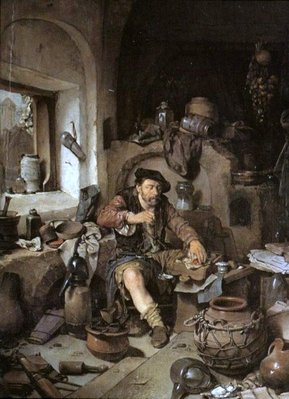
(Featured Image: The Alchemist, by Cornelis Pietersz Bega, 1663)
1 Bread, 2023
2 Crowley was one of the most prominent occultists of the 20th century manipulating public opinion. His followers included politicians, artists, royalty, scientists, philanthropists, actors, musicians, people in publishing and media, economics, military, intelligence…
3 Also, the media, politicians, religious institutions, cults, and secret societies.
4 The name of a book written by Ray Bradbury in 1953. Set in a dystopian future where television is instrumental in people’s lives, and books (or any creative form) no longer exist because they’re deemed offensive and dangerous.